

🐎 Training Load Adaptation for High Performance Horses as a Risk Management Framework | Digital Download!
At $178.5 for a 2.68 GB professional course, Training Load Adaptation for High Performance Horses by Tim Gabbett is positioned far away from generic “conditioning programs.” Its central premise is not intensity, speed, or workload accumulation, but controlled adaptation.
Rather than asking how hard a horse can train, the course reframes the question: how much load can a horse tolerate, adapt to, and repeat without breakdown? This shift places injury risk, biological response, and long-term performance at the center of training decisions.
Free Proof Download – Verified High-Quality Content Included
Get instant access to our official, verified materials — designed to deliver trusted, professional content you can use right away.
Course Overview | Watch the Official Video Sample:
Preview the full experience through our official video and see exactly what’s included in the downloadable version.
Verified Proof of Content Quality:
Explore verified credentials and quality assurance details confirming the authenticity and accuracy of the material.
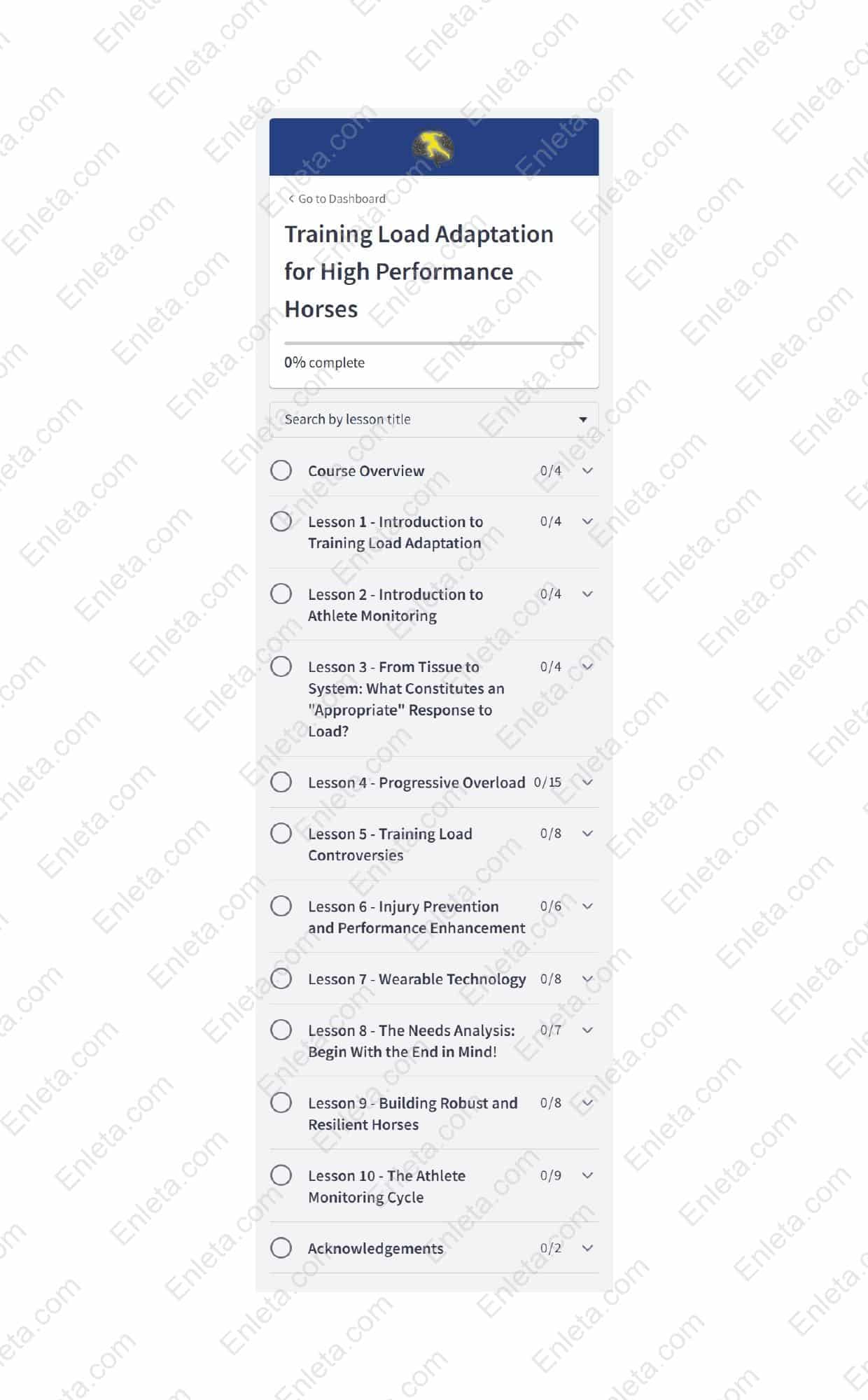
Overview | Preview the Free PDF Sample :
View a high-resolution PDF excerpt to check the structure, design, and depth of information before downloading the complete file.
🚫 Why This Course Is Not for Intuitive or Tradition-Only Training Approaches
This program will likely challenge trainers who rely primarily on intuition, tradition, or static training templates. Training Load Adaptation for High Performance Horses does not dismiss experience, but it refuses to treat experience as sufficient on its own.
If your training philosophy avoids data, monitoring, or objective feedback — or if you believe performance gains must always come from pushing harder — this material may feel restrictive. The course prioritizes measurable response over belief-driven methods.
Who This Program Quietly Serves Best
Once those exclusions are clear, the course aligns strongly with professionals responsible for high-value horses where performance, durability, and welfare must coexist.
This includes:
-
Performance trainers managing elite or competition horses
-
Veterinarians or support staff involved in load planning
-
Coaches working across seasons rather than isolated events
-
Professionals tasked with reducing injury risk without sacrificing output
The program assumes familiarity with training environments and does not simplify concepts for casual audiences.
🧠 Adaptation Over Intensity: The Core Idea Behind the Course
A defining contribution of Training Load Adaptation for High Performance Horses is its emphasis on biological response rather than prescribed workload. Training load is treated as a stimulus, not a guarantee.
The course repeatedly reinforces that tissues, systems, and the organism as a whole adapt at different rates. A session that improves performance in one horse may provoke injury in another. This is why the material emphasizes appropriateness of load rather than magnitude.
🧩 Where Training Errors Commonly Occur
One of the most valuable aspects of the course is how it exposes common misinterpretations of training data. Many performance issues arise not from lack of work, but from mismatched progression.
Typical failure points include:
-
Rapid spikes in workload after perceived “undertraining”
-
Confusing fitness gains with structural resilience
-
Treating averages as safe prescriptions
-
Ignoring cumulative fatigue across training blocks
These errors often emerge despite good intentions, making objective monitoring essential rather than optional.
Progressive Overload as a Decision Process
Progressive overload is not framed as linear escalation. Instead, it becomes a decision-making process that balances frequency, volume, intensity, and recovery — continuously adjusted based on response.
📊 Monitoring Without Overengineering
While the course introduces monitoring tools and concepts, Training Load Adaptation for High Performance Horses does not advocate technology for its own sake. Monitoring is presented as a means to reduce uncertainty, not to eliminate judgment.
The material emphasizes practical interpretation: how to act on signals, when to ignore noise, and how to monitor effectively even with limited resources. This pragmatic stance prevents the course from becoming overly academic.
⚖️ The Role of Controversy and Uncertainty in Load Science
A notable strength of the program is its willingness to address disagreement within training load research. Concepts such as ACWR are explored critically rather than presented as fixed truths.
By examining different calculation methods and their limitations, the course encourages trainers to think probabilistically. Injury risk is framed as something to manage, not something to eliminate — a crucial distinction in high-performance environments.
🧑🏫 Tim Gabbett’s Influence on the Teaching Style
Tim Gabbett’s background in applied sports science shapes a teaching style grounded in translation rather than theory. Research is not presented to impress, but to inform decisions under pressure.
His approach consistently bridges laboratory findings with real-world constraints, acknowledging that perfect data rarely exists in live training contexts. This balance gives the course credibility among practitioners rather than academics alone.
🏁 What Completion Realistically Changes
Completing Training Load Adaptation for High Performance Horses does not provide a universal training template. Instead, it changes how professionals think about load, progression, and risk.
Participants often report greater confidence in planning, improved communication across teams, and a more defensible rationale behind training decisions. The most meaningful outcome is not increased workload, but improved durability and consistency.
Mini FAQ
Is this course only for elite competition horses?
The principles apply broadly, but the course is most relevant where performance and injury risk carry significant consequences.
Does the course require advanced technology?
No. Monitoring concepts are scalable and applicable even with minimal resources.
Is this a purely theoretical program?
No. The focus is on practical decision-making informed by evidence.
Does it replace hands-on experience?
It complements experience by providing a structured framework for interpreting training response.
👉Can’t find the course you’re looking for on Enleta? Contact us and we’ll help you locate it.
🔎 Editorial Conclusion on Training Load Adaptation for High Performance Horses
At $178.5 for a 2.68 GB evidence-based course, Training Load Adaptation for High Performance Horses by Tim Gabbett is best understood as a framework for reducing preventable error in high-performance training.
It does not promise faster results or higher peaks. Instead, it offers a disciplined approach to progressing horses toward performance while respecting biological limits. If your work requires balancing ambition with responsibility, this course may be worth taking the time to explore further and assess how its principles fit your training context.








Reviews
There are no reviews yet.