

🧬 The Summit Academy by Jay Awtani and the Idea of “Market DNA” | Digital Download!
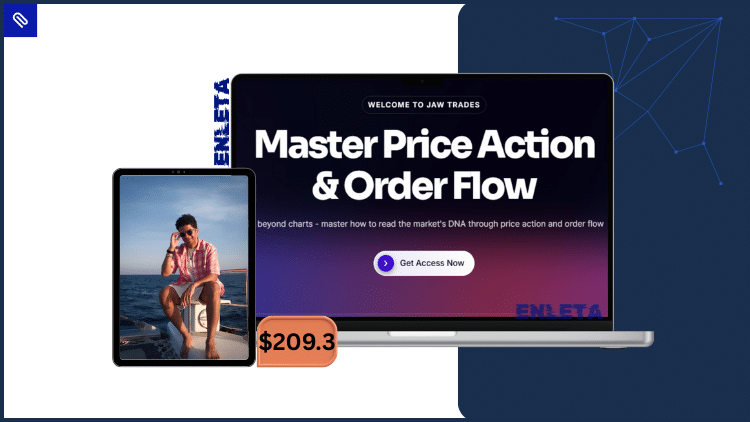
At $209.3 for a 5.65 GB trading program, The Summit Academy by Jay Awtani positions itself away from strategy-first education. Instead, it treats the market as a live interaction between buyers and sellers — something that must be read, not predicted.
The phrase “Market DNA” appears often in the course narrative, but its meaning is practical rather than mystical. It points to a core belief: price action and order flow already contain the information traders seek, if they know how to interpret it without distortion.
Free Proof Download – Verified High-Quality Content Included
Get instant access to our official, verified materials — designed to deliver trusted, professional content you can use right away.
Welcome to The Summit Academy | Watch the Official Video Sample:
Preview the full experience through our official video and see exactly what’s included in the downloadable version.
Verified Proof of Content Quality:
Explore verified credentials and quality assurance details confirming the authenticity and accuracy of the material.
🧠 From Indicator Dependence to Behavioral Reading
One of the quiet arguments of The Summit Academy by Jay Awtani is that many traders outsource decision-making to indicators because they lack confidence in reading raw market behavior.
The program deliberately reduces reliance on:
-
Indicator stacking
-
Signal-based entries
-
Fixed-rule mechanical systems
Instead, it emphasizes understanding why price moves, not just where it might go. This requires traders to tolerate ambiguity longer — something many retail traders initially find uncomfortable.
⚠️ Risk as the First Skill, Not the Last Lesson
Unlike many trading courses that treat risk management as a secondary module, The Summit Academy by Jay Awtani integrates risk thinking early and repeatedly.
Risk is framed as:
-
A positioning decision, not just stop placement
-
A function of account size, volatility, and trade context
-
Something that evolves with trader skill
This approach discourages the fantasy of “growing small accounts fast” without structural discipline. It replaces it with controlled exposure and compounding logic.
🧱 Market Structure as a Framework, Not a Pattern
In the Technical Blueprint section, market structure is not taught as a set of patterns to memorize. Instead, it functions as a contextual map.
Key ideas include:
-
Structure as a reflection of prior participation
-
Levels as zones of interaction, not precise lines
-
Fractals as a way to align multiple timeframes without conflict
This helps traders avoid overfitting setups to historical charts and instead focus on present conditions.
🔎 Inside the Flow: Learning to Observe Without Forcing Trades
The order flow and tape reading section represents a conceptual shift. The Summit Academy by Jay Awtani does not suggest that reading the tape guarantees entries. Rather, it teaches traders to observe commitment, absorption, and hesitation.
Through this lens:
-
Big bids and asks signal intent, not certainty
-
Absorption reveals defense, not immediate reversals
-
Anomalies matter only in context
This reinforces patience — a skill often undervalued in retail trading education.
🧪 Edge Construction as an Iterative Process
Instead of handing out pre-built strategies, The Summit Academy by Jay Awtani walks traders through how edges are constructed, tested, and refined.
This includes:
-
Journaling with intent, not just record-keeping
-
Turning repeated observations into playbooks
-
Aligning setups with trader temperament
The course suggests that an edge is not something you find once, but something you maintain through feedback and adjustment.
🧘 The Mental Summit: Performance Under Uncertainty
The psychology section does not rely on generic motivation. It focuses on probabilistic thinking and neurochemistry — how decision-making changes under stress.
Topics such as fear, opportunity cost, and routine are presented as:
-
Operational variables
-
Performance constraints
-
Skills that require training, not awareness alone
This reinforces the idea that consistency comes from systems, not willpower.
⚖️ Who This Program Is Likely to Help — and Who It Won’t
The Summit Academy by Jay Awtani is best suited for traders who:
-
Want to understand price movement at a deeper level
-
Are open to discretionary, context-driven trading
-
Are willing to practice observation before execution
It is less suitable for those seeking:
-
Fully mechanical systems
-
Indicator-based signals
-
Fast-track profit promises
The course makes no attempt to appeal to everyone — which is arguably one of its strengths.
👤 Jay Awtani’s Teaching Bias and Its Implications
Jay Awtani’s background — trading U.S. markets from Australia, then relocating to Dubai — informs the course tone. There is an emphasis on self-reliance, screen time, and experiential learning.
The course assumes:
-
Traders are willing to put in observation hours
-
Progress comes from skill-building, not shortcuts
-
Mastery is gradual and non-linear
This bias may resonate strongly with traders tired of hype-driven education.
Mini FAQ
Is this beginner-friendly?
Yes, but it assumes commitment and patience rather than quick results.
Does it rely heavily on indicators?
No. Indicators are discussed, but not central to decision-making.
Is order flow required to trade?
Order flow is treated as context, not a mandatory entry trigger.
Is this course strategy-heavy?
No. It focuses more on process and interpretation than fixed setups.
Can’t find the course you’re looking for on Enleta? Contact us and we’ll help you locate it.
🔍 Editorial Conclusion on The Summit Academy by Jay Awtani
At $209.3, The Summit Academy by Jay Awtani offers a structured yet discretionary approach to trading education. Its value lies less in individual techniques and more in how it reshapes the trader’s relationship with price, risk, and uncertainty.
Rather than promising certainty, the program trains perception. For traders ready to move beyond indicators and into market behavior, this may be a framework worth examining carefully.





Reviews
There are no reviews yet.